Tuesday, November 25, 2014

The Solution

While the United States is plagued with high incarceration rates, we do have options to help put money back into the educational system and help our bloated incarceration population. Going back on one of my statistics, the bulk of many of the offenders in jail are there because of non-violent crimes such as drug use and theft. Combining laws that increase prison sentences, curb parole, and cut education and you have a major storm of inmates who are not going to fit in with the outside world and stay a strain on the prison system. The real opponents are the laws that keep these low level criminals in jail for as long as possible which causes more money spent on incarceration and less on education.

The first major solution we have, as reported by The Justice Policy in the article "Education & Incarceration", is to remove "conditions where hundreds of thousands of people with little schooling are coursing through prison". This includes increased parole hearings, reducing sentences, and stop the formation of new prisons. Policy makers are making it harder for inmates to become rehabilitated and off the government's assistance thus causing a major strain on our already thin resources.

Source: Eastern Judicial Circuit of Georgia


The second solution would be to take the non-violent criminals and send them to rehabilitation centers that cost much less than incarceration. Explained in "Treatment or Incarceration?”, rehabilitation costs only about four thousand per year for a drug offender compared to the average twenty thousand to incarcerate them. The money saved, about sixteen thousand, can be instantly spent on education to boost educational spending further ahead than incarceration.

Many of those in prison do not belong in these conditions. Decreasing the time these inmates serve and having special programs to help deal with their problems will most effectively save money to be spent back on education.

By reducing the number of inmates the state has to track and account for, we can reduce the cost of incarceration and finally invest more in education where it can do more good for both our country and for our world.

Source: 
Western, Bruce, Vincent Schiraldi, and Jason Ziedenberg. "Education and Incarceration." Criminal Justice Policy Review (2003): 1-14. Justice Policy. Justice Policy, 28 Aug. 2003. Web. 24 Nov. 2014.

Mcvay, Doug, Vincent Schiraldi, and Jason Ziedenberg. "Treatment or Incarceration?" Criminal Justice Policy Review (2004): 1-23. Justice Policy. Justice Policy, Jan. 2004. Web. 24 Nov. 2014.


How Much Do We Care About Education?

As I stated before, the United States is on an increasing trend of reducing the educational budget in order to accommodate the growing incarceration facilities and bill. Education and graduation rates are decreasing all the while our incarceration is at an all time high and keeps growing. America already houses twenty-five percent of the world's inmates and the trend has no clear views of stopping.

But how much do we actually value our education over incarceration in terms of money. Well CNN Money has a graph titled "Education Vs. Prison Cost" to help decipher the question.

Source: US Census Data and Vera Institute of Justice


As can be observed we place a higher priority on inmates rather than the students in our educational system. Inmates who must rely on the state's assistance and dime to live receive more importance than a student who is working on bettering the United States both economically and politically.

States like Pennsylvania and California spend four times more on incarceration while they fall behind in educational ranking. Only a handful of states spend more than ten thousand on students per year and only a handful of states spend less than twenty thousand on incarceration.

We need to change the importance of incarceration over education. As I have repeated before, incarceration has no economical value. It is a void that gives no return as the inmates do not produce a product. Education on the other hand has infinite potential to boost the economy. With a smarter work force and population, more smart investments are made and work is quickly found for educated citizens.

It is alarming to find out how much states spend on incarceration versus their educational spending. Especially since the United States just came out of a recession and its deficit is still increasing.

Source: "Education vs Prison Costs." CNNMoney. Cable News Network, n.d. Web. 23 Nov. 2014.

Why Schools Are So Important

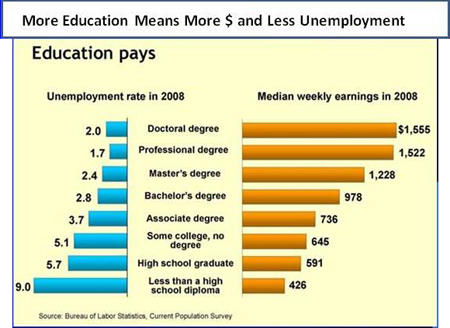
Many people do not understand the sole importance of education. Lets take a moment and talk about the benefits of education rather than the disadvantages of funding incarceration. A study provided by USC titled "Why Is Education Important For Your Future" summarizes the major points of attending school. Those who have a bachelor degree, on average, make at least eighty percent more than those who have a high school degree. Those with bachelor degrees also enjoy more assets such as cars and houses and do not worry as much about finances. They also tend to work in offices where work is less stressful on the body. Not to mention that the higher the education the better your informed choices become.

Source: Bureau of Statistics, Current Population Survey


One of the major consequences on not having an educated youth is economic stagnation and downfall. The Great Recession in 2007 could have been avoided with better consumer education. People used loans they could not pay back or had high interest rates which caused them to be in perpetual debt. Through lack of education, the United States' economy declined and had a high amount of unemployment and bankrupt corporations. 

Educating citizens also has many future benefits. Those who are educated tend to live longer lives. They also push their kids to enroll in higher education causing an exponential growth in an educated population.

By having incarceration cut into the budget of education, many of our benefits are reduced or gone. Incarceration offers only economic disadvantage and families and friends to break up. It also cuts through resources having to build and take care of inmates and also wastes priority on other more helpful programs.

Education can be an incredibly powerful tool. It can strengthen economies and expand power. To decrease its priority to have inmates locked up sounds frivolous and unwarranted. Money is just being burned when invested in the failing incarceration programs.

Source: 
Kezar, Adrianna, Vikki Frank, Jaime Lester, and Hannah Yang. "Why Is Education Important For Your Future." (n.d.): n. pag. USC. USC Center for Higher Education Policy Analysis, May 2008. Web. 21 Nov. 2014.

What Incarceration Is Costing Our Schools

When the government spends more on incarceration, they almost always enact budget cuts on the education system. The more we imprison and take care of prisoners, the more we must cut out of a child's education. The article "Education Vs. Incarceration" presents that "From 2000-2010, Pennsylvania’s inmate population grew 40%, from 36,816 to 51,487" and "the Philadelphia district closed 23 schools and fired thousands of teachers, aides and counselors in the remaining schools" displaying how important increases in incarceration spending affects our education system.

In Philadelphia there is a huge deficit in the city budget. Budget makers had to choose between feeding the unquenchable prison budget or saving one of America's lowest performing school district. In the infographic provided by Jason Killinger, Philadelphia had decreased its budget by about one billion dollars all the while increased its prison spending by nine hundred million. While the incarceration rates rose, the graduation decreased in urban areas by as low as forty-nine percent. Also, the majority of those incarcerated were illiterate and committed non-violent crimes. During these budget cuts Philadelphia declined to the forty-third ranking in its education level. Only one out of every ten high school graduates have a college degree and at the same time one out of every ten dropouts is put in incarceration.

Source: Jason Killinger, Education Vs. Incarceration 2012

The government needs to reprioritize its goals. We need an educated youth to both lead our country and make sure it prospers. Inmates and those on correctional programs have limited or no involvement in supporting our politics and aiding our economy. Dropouts caused by the budget cuts also pose a strain on our economy by using government assistance and only qualifying for low paying jobs in the corporate world. Those who go to college and graduate have a job acceptance rate of eighty-seven percent and make a median of fifty thousand a year.


Government strength stems from the education its citizens receive. A population that is self-aware and assess difficult situations prospers. Education is the key to prosperity and to decrease its funding would result in a stagnation in the welfare of the country. 

Source: "Books Through Bars: Education Versus Incarceration." Books Through Bars. Books                                Through Bars, n.d. Web. 20 Nov. 2014.

The Problem


America is often portrayed as the land of freedom and opportunity. Many American citizens are thankful that they live here and many foreigners dream of finding residence in the land of the free. But recently the United states has been plagued by a bloated and rapidly expanding prison system all the while falling back on education, the world's most important resource. The United States, to this day, leads in the number of incarcerated criminals and is quickly falling behind in educational ranking.

PBS NewsHour hosted NAACP president Benjamin Jealous and Americans for Tax Reform head Grover Norquist to discuss the serious issue of the United State prioritizing incarceration over education. In the video "NAACP Report Calls Shift in Funding Toward Prisons 'Alarming'", Jealous and Norquist discuss the United State's wasteful spending on incarceration and how citizens can keep their tax dollars in their pockets or spent more effectively on education.


Conservative Norquist and Democrat Jealous both agree that incarceration is an enourmous misuse of tax payer money. Most of the inmates in prison are there because of non-violent crimes including drug use and theft. That means inmates who are heroin or meth users are posed as the same threat as rapists and sex offenders. The unequal classification causes the need for more money spent on handling these inmates and erecting even bigger prisons.

The even bigger problem is that all schools do not have the same opportunities and funds to teach effectively. As the budget for the growing prison system increases, education must suffer a lower balance to decrease deficit spending. Many schools in urban areas that receive the lowest funding are the most at risk. Jealous explains that urban schools usually have to sacrifice music and art programs,  have little to no computer access and have more teacher turnovers. The lack of educational programs and strained access to good teachers create a bigger gap to the small amount of students who are motivated to learn and those who do not care about their education.

Jealous sets forth the proposition to remove non-violent criminals from the prison system and put them into rehabilitation centers which he says "dollar for dollar, rehabilitation is seven times more effective." The rehabilitation solution stated by Jealous could put money towards better teachers to engage the students in their lessons and resources for the school to utilize.

Being tough on crime does not mean we must treat every criminal the same. We must take in consideration the crimes they commit and their intent. Classifying murderers with drug abusers leads to a bloated and unnecessary prison population. The United States could instantly start saving money by having non-violent criminals rehabilitated rather than just thrown in a cell, which is extremely costly. The money we could save to spend on school to educate the youth provides a much bigger benefit than locking up inmates who do not deserve harsh jail times.


Source: Woodruff, Judy. "NAACP Report Calls Shift in Funding Toward Prisons 'Alarming'"                                     YouTube. YouTube, 7 Apr. 2011. Web. 19 Nov. 2014.